
"Do I really need a permit for a deck?" is one of the first questions almost every Marietta homeowner asks us, usually hoping the answer is no. For nearly any attached or elevated deck in the City of Marietta or unincorporated Cobb County, the honest answer is yes — and skipping it doesn't just risk a fine, it can quietly cost you a sale years down the road when a buyer's inspector or the closing attorney asks for a permit record that doesn't exist. Here's what's actually being checked when a deck plan goes in front of the building department, so the process stops feeling like a black box.
Engineered Plans: When Are They Required?
Simple, low decks attached to a house sometimes qualify for prescriptive code paths using standard span tables, but anything elevated more than a few feet, anything supporting a hot tub, or anything with an unusual footprint typically needs stamped engineered plans from a licensed engineer. Reviewers are checking that beam sizes, joist spans, and post spacing actually match the load the deck will carry — not just that a plan was submitted. This is exactly the category of build we walk through in more detail in our Marietta deck project timeline, since engineering typically has to be finalized before the permit application can even be submitted.
Setbacks: How Far From the Property Line?
Every residential zoning district in Marietta and Cobb County has minimum setback distances from rear and side property lines, and decks are not exempt just because they're not fully enclosed. A survey or plat showing the proposed deck's distance from each property line is one of the first things a reviewer checks, and it's also one of the most common reasons a first submission gets kicked back for revision. On corner lots or lots backing up to greenspace near areas like East Cobb, setback rules can be stricter than homeowners expect, so it's worth confirming before a design is finalized rather than after.
Footing Depth: Why Cobb County's Clay Soil Matters
Footing depth requirements are tied to frost line and soil bearing capacity, and Cobb County's dense red clay behaves differently than sandier soil in other parts of the state — it holds water longer after heavy rain and can shift slightly with wet-dry cycles if footings aren't poured deep and wide enough. Inspectors specifically check footing depth, diameter, and that concrete has been poured against undisturbed soil rather than loose backfill, before any framing goes on top. Skipping this step to save a day of digging is the single most common reason older, unpermitted decks fail structurally years later.
Inspections: What Happens On-Site
A typical deck permit involves at least two inspections: a footing inspection after the holes are dug but before concrete is poured, and a framing inspection before the decking boards go down and hide the structure underneath. Some jurisdictions also require a final inspection covering railing height, baluster spacing, and stair details. Each inspection is a checkpoint where a mistake is still cheap to fix — which is the entire point of the process, even though it can feel like it's just slowing the project down.
Why This Matters at Resale
An unpermitted deck doesn't disappear from a home's history — it shows up as a red flag on a home inspection report, and in Georgia, sellers are required to disclose known unpermitted work. Buyers and their agents increasingly ask directly, and a deck without permit records can trigger a demand for a retroactive inspection, a price reduction, or in some cases a requirement that the deck be brought up to code or removed before closing. Compare that to the modest upfront cost breakdown we cover in our Marietta deck cost guide, and the permit fee looks like cheap insurance against a much larger headache later.
We Handle the Permit Process for You
Plans, submission, and every required inspection — pulled and scheduled by us, not left for you to figure out.
📞 Call 470-327-9145How Much Does a Deck Permit Actually Cost?
Permit fees in Marietta and Cobb County are typically calculated based on the estimated construction value of the deck, often landing somewhere between a couple hundred dollars and a few hundred dollars for a typical residential deck, with engineering fees on top if stamped plans are required. Compared against the overall project numbers covered in our Marietta deck cost guide, permit and engineering fees usually represent a small fraction of the total budget — often less than the cost of upgrading from standard balusters to a premium railing system. It's a modest line item next to what it protects.
Do HOA Rules Add Another Layer?
Beyond the City of Marietta and Cobb County's own permit requirements, many neighborhoods throughout the area also have homeowners' association covenants governing deck size, material, color, and even railing style, and those rules exist independently of the county building permit process. An HOA approval and a building permit are two separate steps, and skipping the HOA side can mean a compliant, permitted deck still ends up the subject of a violation letter. We ask about HOA covenants early in design specifically to avoid a homeowner having to redo work that already passed county inspection.
What If You're Fixing an Existing Unpermitted Deck?
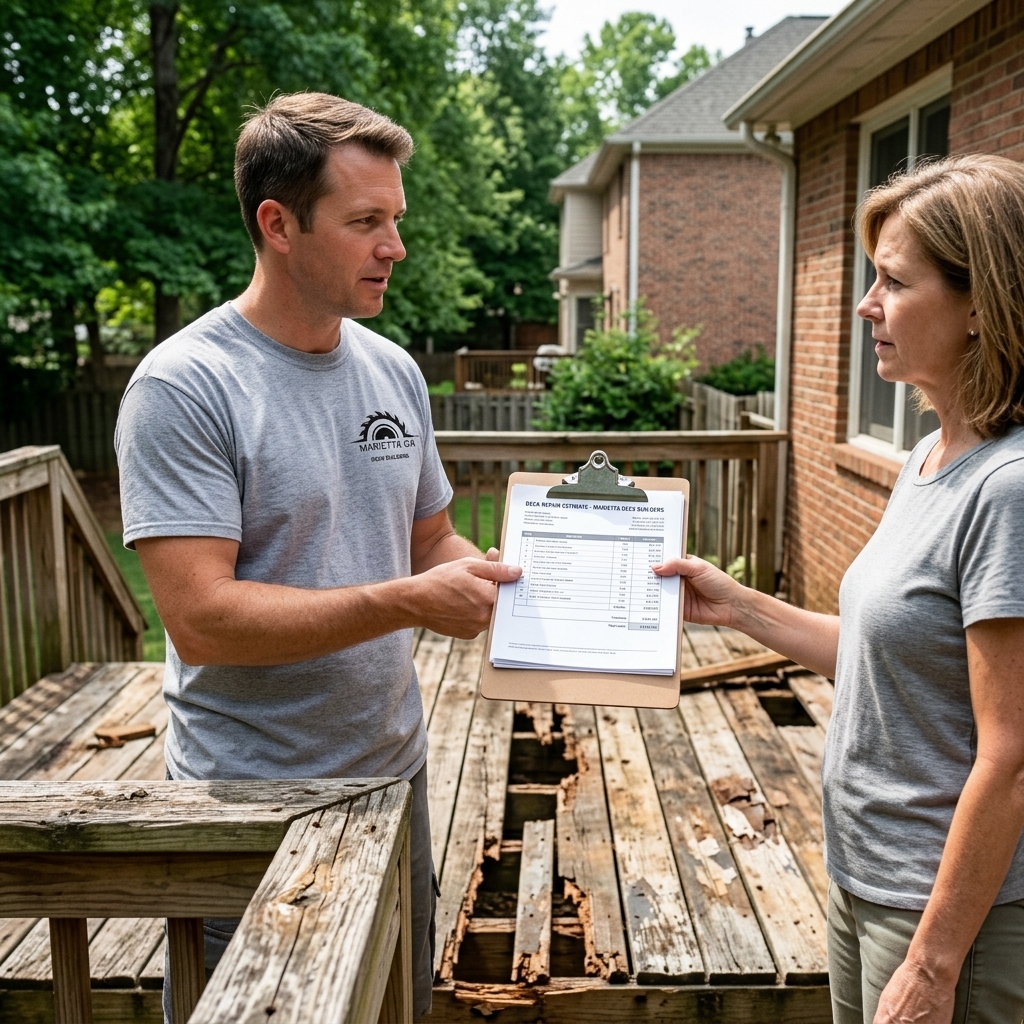
If you've bought a home in Marietta or nearby Acworth with a deck you suspect was never permitted, the fix usually starts with an honest structural evaluation rather than a full teardown — our deck repair and restoration team can assess what's salvageable and what needs to be brought up to current code. Either way, going through the process properly the first time, with engineered plans, correct setbacks, adequate footings, and scheduled inspections, is what turns a deck from a liability on paper into a genuine asset when it's time to sell.